Note 12
A whole-body strength practice, one move at a time.
The Turkish get-up is a whole-body strength practice that rewards patience, control, and attention to the way each movement connects.
Back to the Journal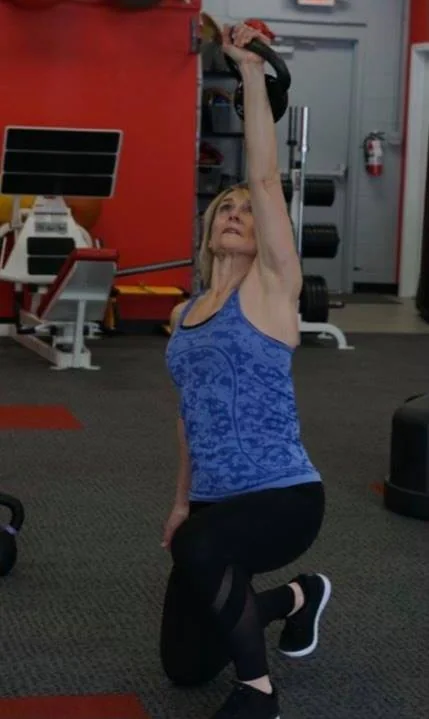
The Turkish Get-Up is one of my favorite exercises. I started doing it years ago without weight and now I am able to do it with a 25 to 35 pound dumbbell or kettlebell. I love it.
Benefits of the Turkish Get-Up
- Improve mobility
- Enhance core stability
- Build strength
- Prevent injury by strengthening all areas of the body
- Improve flexibility
- Activate glutes
- Stabilize rotator cuff
- Improve coordination
Step-by-step technique
Begin lying on your back (supine). Bend the right knee and hold the right arm straight up overhead. Keep your eyes fixed on the right hand for the entire sequence.
- Roll onto your left elbow while driving through your right heel. Get tall.
- Use your left palm to push up from the floor and sit tall.
- Sweep your left leg behind you and bring it under your body. Your left hand, knee, and foot should form a straight line.
- Position yourself above your left heel and move into a half-kneeling position (left knee down, right knee up, knees facing forward).
- From the half-kneel, engage your core and push your back foot into the floor to bring your feet together into a standing position. You are halfway there!
- Reverse these steps in order to perform the “get-down.”
- Repeat the entire sequence with the opposite side.
Progressions and coaching tips
Initially, practice each component of the movement separately to build the strength and motor control needed for the full Turkish Get-Up. This progression makes it easier to combine the steps into a fluid, safe sequence.
I use this exercise often in my own workouts and with my clients. If you have questions or want guidance, let me know, I'm always here to help.
About the author
Veronica Lane, MHS, PT. Physical Therapist & NASM-certified personal trainer who specializes in pelvic floor therapy. Located in STL, MO.